The last few days have been extremely volatile. If you have watched the last interview I gave on ET NOW, I had mentioned that my sense is we will remain extremely volatile in the next 4-6 months before things get better. For those who might have missed it, here is the link. Margin pressure will ease because raw material prices are likely to stabilise. Inflation will also start looking better because last year's high base rate will come into the picture and year-on-year growth in inflation will look lesser. Also, with the passage of time, the knee-jerk reaction of market participants will also likely reduce.
Equity Advisory
Thursday, 5 May 2022
What to do now?
Sunday, 1 May 2022
Are these returns real?
The bane of any momentum portfolio is slippage. You might see a particular return being displayed by the system but when you actually go and run it yourself with real money you find that you are not getting the returns. And at times, it is not even close to what the system promises.
Returns lag due to many reasons. High cost of brokerage and transaction costs is one. This is why we always suggest using discount brokers to keep costs as low as possible. Slippage is also another major concern. Especially for "breakout momentum" systems. We do not use a breakout momentum system precisely because of this reason.
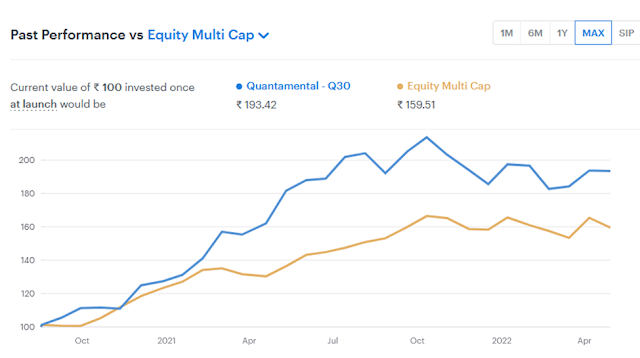
Are these returns real? We have often been asked this question. But first some context. Q30 was launched on 28th Feb 2020 (2 years and 2 months) and has been live on the Smallcase platform since 17th Aug 2020 (1 year 8 months). We were using our own model portfolio sheet to calculate and report returns till Aug 20 and switched to reporting returns based on smallcase provided numbers from thereon, as it is a reliable third party and we can’t report inaccurate numbers even by mistake.
Smallcase so far was taking prices of stocks on the day of upload of rebalances, whereas subscribers were buying and selling on the next trading day and there was a lingering doubt in our minds as to how much is the loss due to slippage and how different is the actual returns for investors compared to the model portfolio.
Smallcase has made changes to their method and now it will now take prices as on the day when it is available for action by users. It would also take the average of OHLC (open high low and closing prices) so that price is fairly representative of actual user transacted prices during the day.
The CAGR numbers that you see below are now based on prices on the day when rebalance was available for users to execute. Since 17th August 20, Q30 CAGR is ~47%. This is after taking into account slippage. And it has beaten the benchmarks by a huge margin.
But what about brokerage? How much is being lost in churn due to brokerage?
Starting with 10 lakhs on 17th Aug 20, the capital has compounded at ~46% CAGR in the last 1 year 8 months post all slippage, brokerage and advisory fees. Few conclusions
1. Annualized brokerage comes to about 1.6% well within 2% estimates we have communicated based on our churn %
2. Advisory fee comes to less than 1% annualized. Of course, this would be lower if higher capital is invested and higher if much smaller capital is invested. But it does give you a very clean and clear perspective of what the actual scenario is.
1. Q30 is one of the lowest slippage portfolios around.
2. Doubts on post slippage and post brokerage returns have been laid to rest with change in returns calculation methodology.
3. Over longer rolling periods we expect Q30 to perform better than the market and provide reasonable returns with minimal effort (less than 15 mins a month).
Next week we will look into similar data for Q10.
Friday, 29 April 2022
Weekend Reading
Mobility is everything, or so the fitness gurus would have you believe. But the focus on mobility and movement isn’t new. It’s as old as 1965, when a Japanese firm launched the pedometer and popularised the idea that taking 10,000 steps daily leads to better health. The company was Yamasa Clock and Instrument Company, and its pedometer was called Manpo-kei, which translates to “10,000 steps meter” in Japanese. A 2019 study on daily step count by researchers from Harvard Medical School, surmised that this is where the magic number of 10,000 steps comes from. In a separate study published in Lancet last month, researchers wrote that, “Although 10,000 steps per day is widely promoted to have health benefits, there is little evidence to support this recommendation.”
For this study, published in the Lancet, researchers analysed 15 studies that covered the health and fitness of over 47,000 people, over a period of seven years. They found that while “10,000 steps” is a myth, there are health benefits for adults who clocked more steps. Adults who walked more had a 40% to 53% lower risk of mortality. They also found that taking more steps per day was associated with a progressively lower risk of all-cause mortality but varied by age. There was progressively lower risk of mortality among adults aged 60 years and older who walked about 6,000–8,000 steps per day, and among adults younger than 60 years who walked about 8,000–10,000 steps per day.
2. Autonomous taxi is now starting off in China
Pony.ai has received a license to operate its autonomous taxi service in China, making it the first company to win the country’s approval (via Reuters). Starting in May, the Toyota-backed robotaxi service will operate 100 autonomous vehicles in the Nansha district of Guangzhou, and will later expand to serve other portions of the city.
Pony.ai says riders can hail and pay for rides from the company’s app between 8:30AM to 10:30PM, and that its fares will align with the “standard taxi pricing” in Guangzhou. The autonomous vehicles will also have a driver present in the car for safety purposes, but plans to remove them over a “short to intermediate time frame.”
https://www.theverge.com/2022/
3. Playing status games
Status is one of humanity’s great poisons, but it’s so deeply engrained in our evolutionary makeup that we continue to drink from its fountain whenever we can. It’s an unsurprising fact that animals arrange themselves based on hierarchical power structures, but what’s surprising to me is how readily human beings follow that same behavior without much thought.
Much of the “creator economy” has less to do with what one creates, and more to do with the status one exudes. Perhaps in the beginning, the work has to speak for itself, but after a certain point, what matters more is the identity of the person creating the work as opposed to the work itself.
https://moretothat.com/the-
4. How to be happy?
The modern world almost universally tells us that what will make us happy is acquisition of some kind. The raison d'ĂȘtre of modern life seems to be to receive. To go further even, to take. Just think of that dehumanizing label given us by advertisers: “consumer”. As if we were mere locusts. Alas, it is a great sadness that many of us have allowed ourselves to become just that, we but hope not irredeemably.
“He who dies with the most toys wins” is meant to be a dark joke, not wise counsel to be pursued.
Selfishness is a great plague on the human spirit. A life of self-denial is simply one in which getting what you want is not the axis on which the world spins. You may get what you want, you may not, but you no longer make that the condition for your well-being. Ideally, you abandon the concern altogether and seek to give of yourself and what you have as much as possible.
Treat everything you do as if it is the most important thing you could possibly be doing. You’ll soon find that it is. Give everything you’ve got to it. That’s purpose. That’s the path to true happiness that everyone is seeking. We just have to remember this and walk in it. Simple, if not always easy.
https://thinkonthesethings.
5. The quest for superhuman healing
Mammals, from tiny rodents to humans, never usually recover from serious spinal cord or other central nervous system injuries. Except, it seems, for the African spiny mouse.
In recent years, scientists have discovered that this creature, found in arid habitats in African countries including Kenya, Somalia and Tanzania, has an extraordinary gift for regeneration. It can overcome devastating injuries to its skin, heart, kidneys and spinal cord.
The African spiny mouse joins a special list of otherwise non-mammalian species known to be able to regenerate important parts of their bodies. Regeneration is a specific form of wound healing that replaces lost tissues more or less like-for-like, avoiding excessive scarring, so that the body part in question can function just as well as it did before. Axolotls, flatworms, zebrafish and some jellyfish can regenerate relatively large and complex parts of their bodies, for instance. And newly hatched alligators can regrow severed tails, according to a study published in 2020. But none of these animals are as closely related to us, genetically speaking, as the African spiny mouse.
https://www.bbc.com/future/
Friday, 22 April 2022
Lindy Effect and the Challenges of Long Term Forecasting
In the last few years, Lindy Effect has gained a lot of popularity amongst investors. Ever since Nassim Nicholas Taleb wrote about it in his 2012 book "Antifragile: Things That Gain from Disorder", it has been used in the investing world as a concept that says companies with a competitive advantage that have survived for many years are more likely to survive for many more years.
To quote Taleb,
"If a book has been in print for forty years, I can expect it to be in print for another forty years. But, and that is the main difference, if it survives another decade, then it will be expected to be in print another fifty years. This, simply, as a rule, tells you why things that have been around for a long time are not "aging" like persons, but "aging" in reverse. Every year that passes without extinction doubles the additional life expectancy. This is an indicator of some robustness. The robustness of an item is proportional to its life!"
The concept is named after Lindy's delicatessen in New York City, where the concept was informally theorized. Lindy was a very popular restaurant that started in 1921. A restaurant running for nearly 90 years was supposed to last for another hundred and eighty years as per Taleb's theory.
The irony is Lindy shut its doors permanently in 2017. So much for theory!
And this is not the only example. "Built to Last: Successful Habits of Visionary Companies", a bestseller by Jim Collins and Jerry Porras published in 1994 identified 18 companies that were built to not only built to last but built to excel.
The list of companies identified by the authors was as below:
* 3M
* American Express
* Boeing
* Citicorp
* Disney
* Ford
* General Electric
* Hewlett Packard
* IBM
* Johnson & Johnson
* Marriott
* Merck
* Motorola
* Nordstrom
* Philip Morris
* Procter & Gamble
* Sony
* Walmart
Amongst them are companies like General Electric, Motorola, Ford, Sony, Boeing, Nordstrom, IBM, HP who are mere shadows of their former glorious selves.
The points I am making are simple:
1) Don't listen to pundits giving lectures on durable competitive advantage. Nothing lasts forever. People die. Trends change. Preferences change. If you don't want to lose money, start with the premise that all businesses are fragile and will die sooner rather than later.
2) No one knows much about what is going to happen in the long term future. We are all deterministic beings in a probabilistic world.
3) Have a risk management plan for your investments, which is preferably a quantitative one. Because when things get rough, trust yourself to self-sabotage unless you have a well-defined system.
4) When you are losing money in an investment, don't average down. You may think you know everything about the business. But you don't. You are just kidding yourself. (The only time to average down is when the overall market has corrected and your stock is down along with everything else.)
This article first appeared in The Economic Times.
Thursday, 21 April 2022
Weekend Reading: 22-Apr-22
You can sign up to https://www.getrevue.co/profile/intelsense to receive all blogs from me directly into your inbox.
1. The story of the rice cooker and economic development of women in post-war Japan
The automatic rice cooker was invented at the dawn of the modern Japanese kitchen and commercialised for home-use by Toshiba in 1955. Collaborating engineer Minami Yoshitada of Koushin-sha and his wife Fumiko experimented with temperatures and cooking times before concluding that automatically switching the power off when the water reaches a boil would adequately steam the rice to its optimal tenderness in about twenty minutes. The result: the Toshiba Automatic Rice Cooker model ER-4, designed by Iwata Yoshiharu, was Japan’s first successfully mass-produced rice cooker.
In the last century, no domestic space in Japan has been transformed by design and technology more than the kitchen.
By combining the dining and kitchen into a single space, Hamaguchi legitimised womens’ labour by making it visible to the head of the household, while also improving efficiency. In doing so, Hamaguchi presented household labour as an important contribution to the economy during a time in which the Japanese government was focused on the economic development of the country.
https://artreview.com/work-of-the-week-toshiba-rice-cooker/
2. Reversible & irreversible decisions
Jeff Bezos breaks up decisions into two types: Type 1 and Type 2. He compares them to two types of doors. Type 1 decisions are irreversible. This door only opens one way – once you enter the room you cannot get out. It is very difficult if not impossible to reverse the decision. A Type 2 decision is like a door that opens both ways – you can get in and out easily. Bezos argues that corporations don’t distinguish between Type 1 and 2 decisions. Type 1 decisions should be thoughtfully weighed. Type 2 decisions can be made fast.
In your early 20s, some Type 1 decisions require careful deliberation, some don’t. Choosing a career and your soulmate do. Drinking and driving or getting in a car with a drunk roommate at the wheel, don’t. There is an Uber app for that.
https://contrarianedge.com/turning-a-pbs-interviewer-into-interviewee/
3. Eat 2-3 times a day while in an intermittent fast
Keeping blood glucose levels down requires eating more regularly than once a day, Manoogan says, as this prevents the body thinking it's starving and releasing more glucose when you do eventually eat in response.
Instead, she says, two to three meals a day is best – with most of your calories consumed earlier in the day. This is because eating late at night is associated with cardio-metabolic disease, including diabetes and heart disease.
"If you eat most of your food earlier on, your body can use the energy you feed it throughout the day, rather than it being stored in your system as fat," Manoogan says.
But eating too early in the morning should be avoided, too, she says, as this wouldn't give you sufficient time to fast. Also, eating too soon after waking up works against our circadian rhythm – known as our body clock – which researchers say dictates how the body processes food differently throughout the day.
https://www.bbc.com/future/article/20220412-should-we-be-eating-three-meals-a-day
4. You have to be a learning machine for the rest of your life
As AI and robotics continue to advance, there are concerns that machines could soon replace humans in a wide range of occupations. Now there’s a new way to tell how likely your job is to be taken over by robots or AI, and what job to shift to if you are at risk.
Workers losing out to automation is not a new phenomenon. As the researchers note in a paper published in Science Robotics, the mechanization of agriculture and automation of manufacturing led to significant changes in the structure of the workforce. But they point out that this time around, these changes may be far more disruptive.
While previous waves of automation primarily affected low-skill jobs, the rapidly improving capabilities of machines mean that medium and high-skill occupations are increasingly at risk. The pace of progress also means that jobs may change far faster than before, opening up the prospect that workers will have to retrain and acquire new skills multiple times throughout their lifetimes.
5. Haptic Touch tech now to be used in robotic surgery
Haptics is the science and technology of sending and getting data through touch. At its generally essential, “haptic” amounts to something connecting with the feeling of touch. (It’s gotten from the Greek word for contact.)
Haptic Touch is a particular type of haptic input that utilizes vibrations to imitate sensations like squeezing a button or looking at a rundown when you do it on your screen. For instance, assuming you hold your finger on an application symbol, you’ll feel a vibration as a menu opens.
A new robot control technology called haptic technology is being created to give tactile input to the human surgeon while directing the automated movement. Haptic technology gives tactile criticism to the controls and permits clients to actually contact, feel, and control three-layered objects. They can exactly control the placement of the robot’s end-effector (the finish of the robot arm that holds the device).
Haptics in Virtual Reality (VR) offers an additional aspect by allowing clients to feel the virtual environment not just through faculties, for example, voice-based or vision-based connection in addition to the feeling of touch. It is basic to consider the drenching and connection parts of VR to get a sensible discernment of the fake world.
https://www.analyticsinsight.net/haptic-technology-is-the-next-big-thing-in-robotics-and-vr/
~~~~~~~~~~~~~~~~~~~~~~~~
Friday, 15 April 2022
Weekend Reading: 16-Apr-22
Reading across disciplines is one of the best ways to improve our investment acumen. Here is a summary of some of the best articles I read this week. If you like this collection, consider forwarding it to someone who you think will appreciate it.
Noise is not just bias
Bias refers to judgments that depart from rationality in consistent, predictable ways. If you ask people to estimate the likelihood of dying in a plane crash, you can predict their answers will generally be biased upward because airline accidents are so vividly covered in the media and readily come to mind (the availability bias). In contrast, noise means that judgments are unpredictable, or scattered. If you ask a group of people to guess the weight of a bull, their answers will not be biased. They will be noisy, meaning they all depart from the true weight of the bull in unforeseeable ways.
Bias is characterized by systematic deviation in a predictable manner. Noise refers to random scatter. Interestingly, you don’t need to know the true answer to a question in order to infer the presence of noise in people’s judgments. For instance, if you ask 10 different physicians to diagnose a patient and they each return a different answer, then you can conclude that their answers are noisy, even if the true diagnosis remains unknown.
https://quillette.com/2022/04/
Concrete steps to lead a more contented life
- Give yourself the permission to treat yourself just like you would treat your friends or family members when they screw up. Allow yourself to be imperfect.
- See the difference between making a bad decision and being a bad person. Making a bad decision does not automatically make you a bad person.
- Accept that you are human and will necessarily make mistakes. This sense of vulnerability will also make you feel more connected to other people, as you realise that we all struggle.
- Recognise your flaws and setbacks as learning experiences and opportunities to grow. Embrace these challenges, persist in finding meaning in them and, most importantly, don’t give up on yourself.
- Practise gratitude. By noticing, affirming and appreciating the good things in your life, you will reduce the focus on what you don’t have. Gratitude can create a buffer against feelings of inadequacy and the tendency to ruminate.
- Stay in the present. Being mindful of where you are and what you’re doing can help you tamp down negative thoughts. However, it doesn’t mean that you should ignore the past. As the Danish philosopher SĂžren Kierkegaard said, “Life can only be understood backwards; but it must be lived forwards.”
- Focus on helping others. Generosity has great restorative function. However, you must consciously choose the recipients of your generosity, in light of your resources (from mental, physical, emotional to financial).
https://knowledge.insead.edu/
The more you have, the more you want
Inhabitants of prestigious institutions are even more interested than others in prestige and wealth. For many of them, that drive is how they reached their lofty positions in the first place. Fueling this interest, they’re surrounded by people just like them—their peers and competitors are also intelligent status-seekers. They persistently look for new ways to move upward and avoid moving downward.
The French sociologist Ămile Durkheim understood this when he wrote, “The more one has, the more one wants, since satisfactions received only stimulate instead of filling needs.” And indeed, a recent piece of research supports this: it is the upper class who are the most preoccupied with gaining wealth and status. In their paper, the researchers conclude, “relative to lower-class individuals, upper-class individuals have a greater desire for wealth and status…it is those who have more to start with (i.e., upper-class individuals) who also strive to acquire more wealth and status.” Plainly, high-status people desire status more than anyone else.
https://quillette.com/2019/11/
Reading voraciously is a competitive advantage
During his five-year study of more than 200 self-made millionaires, Thomas Corley found that they don’t watch TV. Instead, an impressive 86 percent claimed they read — but not just for fun. What’s more, 63 percent indicated they listened to audiobooks during their morning commute.
Productivity expert ChoncĂ© Maddox writes, “It’s no secret that successful people read. The average millionaire is said to read two or more books per month.” As such, she suggests everyone “read blogs, news sites, fiction and non-fiction during downtime so you can soak in more knowledge.” If you’re frequently on the go, listen to audiobooks or podcasts.
Maybe you’re thinking: Who has the time to sit down and actually read? Between work and family, it’s almost impossible to find free time. As an entrepreneur and a father, I can relate — but only to an extent. After all, if Barack Obama could fit in time to read while in the White House, what excuse do you have? He even credits books to surviving his presidency.
President Obama is far from the only leader to credit his success to reading. Bill Gates, Warren Buffett, Oprah Winfrey, Elon Musk, Mark Cuban and Jack Ma are all voracious readers. As Gates told The New York Times, reading "is one of the chief ways that I learn, and has been since I was a kid."
https://www.entrepreneur.com/
Humans continue to evolve
Evolution is a gradual change to the DNA of a species over many generations. It can occur by natural selection, when certain traits created by genetic mutations help an organism survive or reproduce. Such mutations are thus more likely to be passed on to the next generation, so they increase in frequency in a population. Gradually, these mutations and their associated traits become more common among the whole group.
By looking at global studies of our DNA, we can see evidence that natural selection has recently made changes and continues to do so.
Survivors of infectious disease outbreaks drive natural selection by giving their genetic resistance to offspring. Our DNA shows evidence for recent selection for resistance of killer diseases like Lassa fever and malaria. Selection in response to malaria is still ongoing in regions where the disease remains common.
Humans are also adapting to their environment. Mutations allowing humans to live at high altitudes have become more common in populations in Tibet, Ethiopia, and the Andes. The spread of genetic mutations in Tibet is possibly the fastest evolutionary change in humans, occurring over the last 3,000 years. This rapid surge in frequency of a mutated gene that increases blood oxygen content gives locals a survival advantage in higher altitudes, resulting in more surviving children.
https://phys.org/news/2018-11-
~~~~~~~
#Q30 is up ~7% so far in April. When the markets are trending, the moves can be sharp and big. (Q30 had a best-ever month of 18%+ in a single month on Feb 21.) A momentum strategy keeps you firmly where the action in the market is!
Check it out at: https://intelsense.smallcase.com
Thursday, 7 April 2022
Weekend Reading - 08-Apr-22
Reading across disciplines is one of the best ways to improve our investment acumen. Here is a summary of some of the best articles I read this week. If you like this collection, consider forwarding it to someone who you think will appreciate it.
You can sign up to https://www.getrevue.co/profile/intelsense to receive all blogs from me directly into your inbox.